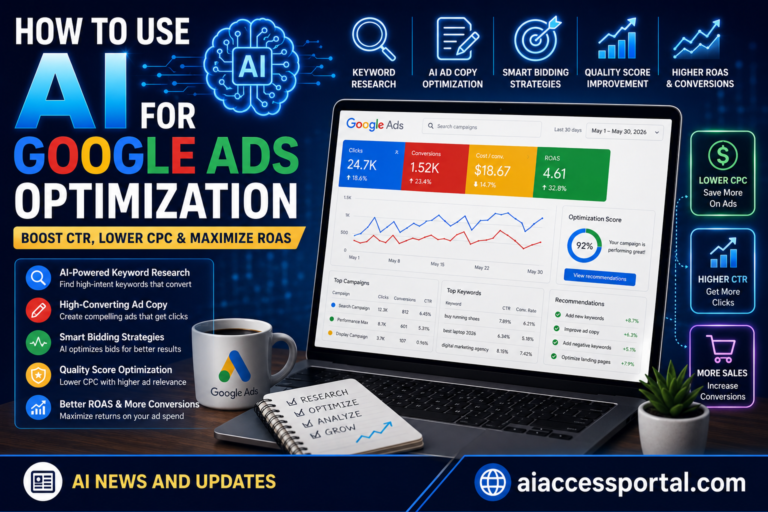
Google Ads remains one of the most powerful digital advertising platforms in the world. However, increasing competition and rising advertising costs have made campaign optimization more challenging than ever.
Fortunately, artificial intelligence is transforming how businesses manage Google Ads.
From keyword research and ad copy creation to bid optimization and conversion analysis, AI helps advertisers make smarter decisions while reducing the time required to manage campaigns.
Whether you’re a small business owner, marketing manager, freelancer, or agency professional, learning how to use AI for Google Ads optimization can significantly improve your advertising performance in 2026.
In this complete guide, you’ll discover practical ways to leverage AI for better click-through rates, lower costs, and higher returns on advertising spend.
Why AI Matters for Google Ads
Managing successful Google Ads campaigns requires analyzing large amounts of data.
Advertisers must monitor:
- Keywords
- Search terms
- Ad copy performance
- Conversion rates
- Quality Scores
- Bidding strategies
- Audience behavior
AI can process this information much faster than humans and identify patterns that may otherwise go unnoticed.
As a result, businesses can make better decisions and improve campaign efficiency.
Benefits of Using AI for Google Ads
Businesses that incorporate AI into their advertising workflows often experience:
Better Click-Through Rates (CTR)
AI helps generate multiple ad variations, allowing advertisers to test headlines and descriptions more effectively.
Lower Cost Per Click (CPC)
By improving ad relevance and Quality Score, AI can contribute to lower advertising costs.
Higher Conversion Rates
AI identifies high-intent keywords and audience segments that are more likely to convert.
Faster Campaign Optimization
Instead of manually reviewing data for hours, AI can provide recommendations within minutes.
Improved Return on Ad Spend (ROAS)
Better targeting and optimization often lead to increased profitability.
Step 1: Use AI for Keyword Research
Keyword research is the foundation of every successful Google Ads campaign.
AI can help uncover:
Long-Tail Keywords
These keywords typically have lower competition and higher purchase intent.
Examples:
- Best CRM software for small businesses
- Affordable digital marketing agency near me
- AI content writing tools for bloggers
Problem-Based Keywords
Users often search based on problems they want to solve.
Examples:
- How to reduce website bounce rate
- Improve Google Ads conversions
- Lower advertising costs online
Comparison Keywords
High-intent users frequently compare products before purchasing.
Examples:
- Product A vs Product B
- Best alternative to [competitor]
- Compare marketing automation tools
Finding these opportunities manually can take hours, while AI can generate hundreds of ideas quickly.
Step 2: Create Better Ad Copy with AI
Writing effective ads requires creativity, testing, and audience understanding.
AI can generate multiple headline and description variations instantly.
Strong Headlines
Effective headlines typically include:
- Keywords
- Benefits
- Numbers
- Calls-to-action
Examples:
- Boost Sales with AI Marketing
- Save 40% on Advertising Costs
- Get More Leads Starting Today
- Improve Your Google Ads Results
Engaging Descriptions
AI can help create descriptions that:
- Highlight benefits
- Address pain points
- Build trust
- Encourage action
Testing multiple combinations often improves overall performance.
Step 3: Improve Quality Score
Google’s Quality Score affects:
- Ad rank
- Cost per click
- Campaign visibility
Quality Score depends on:
Keyword Relevance
Your keywords should closely match ad content.
Ad Relevance
Ads should align with user search intent.
Landing Page Experience
Visitors should find exactly what the ad promises.
AI helps optimize all three areas by ensuring consistency between keywords, ads, and landing pages.
Step 4: Analyze Search Terms
Search term reports reveal the exact queries users typed before clicking an ad.
AI can quickly identify:
Winning Keywords
Search terms generating conversions should often become dedicated keywords.
Negative Keywords
Terms generating clicks without conversions can be excluded to save budget.
New Opportunities
Unexpected search behavior often reveals profitable new keyword ideas.
Regular analysis helps eliminate wasted spending.
Step 5: Optimize Landing Pages
Even the best ads fail if landing pages do not convert.
AI can improve:
Headlines
Matching landing page headlines to ad copy increases relevance.
Calls-to-Action
AI can suggest stronger CTA language.
Examples:
- Start Free Trial
- Book Your Consultation
- Get Instant Access
- Claim Your Discount
Content Structure
Improved readability often increases conversions.
AI can help organize content into:
- Clear sections
- Bullet points
- Benefit-focused messaging
- Customer testimonials
Step 6: Use AI for Bid Strategy Decisions
Choosing the right bidding strategy is essential.
AI can help determine whether to use:
Maximize Conversions
Best for advertisers seeking more leads or sales.
Target CPA
Useful when maintaining a specific acquisition cost.
Target ROAS
Ideal for ecommerce campaigns focused on profitability.
Maximize Clicks
Helpful when driving traffic is the primary goal.
Analyzing campaign data manually is time-consuming, while AI can evaluate performance metrics quickly.
Step 7: Monitor Competitor Advertising
Understanding competitor strategies helps improve your own campaigns.
AI can assist with:
Competitor Keyword Analysis
Discovering keywords competitors target.
Ad Messaging Review
Identifying common selling points and promotional offers.
Market Positioning
Finding opportunities competitors may be overlooking.
These insights can help create stronger, more differentiated advertising campaigns.
Best AI Tools for Google Ads Optimization
ChatGPT
Useful for:
- Ad copy creation
- Keyword ideas
- Search term analysis
- Campaign recommendations
Claude AI
Excellent for:
- Strategic planning
- Competitor analysis
- Landing page optimization
- Detailed performance reviews
Google Ads AI Features
Google itself offers AI-powered tools including:
- Responsive Search Ads
- Smart Bidding
- Performance Max Campaigns
- Audience Signals
These features automate many optimization tasks.
Semrush
Helpful for:
- Competitor research
- Keyword intelligence
- PPC analysis
Optmyzr
Designed specifically for PPC campaign management and automation.
Common Google Ads Mistakes AI Can Help Prevent
Broad Targeting
AI can identify audience segments most likely to convert.
Weak Ad Copy
Multiple AI-generated variations improve testing opportunities.
Ignoring Negative Keywords
AI can quickly identify wasteful search terms.
Poor Landing Page Alignment
Consistency between ads and landing pages improves Quality Score.
Limited Testing
AI allows advertisers to generate and test more variations faster.
Frequently Asked Questions About how to use ai for google ads optimization
Can AI completely manage Google Ads campaigns?
AI can automate many tasks, but human oversight remains important for strategy, budgeting, and business decisions.
Which AI tool is best for Google Ads?
ChatGPT and Claude AI are among the most versatile options for keyword research, ad creation, and campaign optimization.
Does AI improve Quality Score?
Yes. AI can improve keyword relevance, ad copy alignment, and landing page consistency, all of which contribute to higher Quality Scores.
Can AI reduce advertising costs?
AI often helps lower costs by improving targeting, eliminating wasteful keywords, and optimizing ad relevance.
Final Thoughts
Artificial intelligence is changing Google Ads management in 2026. Advertisers who embrace AI gain access to faster research, better optimization, and deeper insights than ever before.
From discovering profitable keywords and creating compelling ad copy to improving Quality Scores and analyzing campaign performance, AI provides a significant competitive advantage.
The most successful advertisers combine AI-powered automation with human expertise, creating campaigns that are both data-driven and strategically focused.
If you want better Google Ads performance, lower costs, and higher returns, integrating AI into your advertising workflow is no longer optional—it’s becoming essential.
About the Author
The AI Access Portal editorial team researches artificial intelligence, paid advertising, marketing automation, and digital growth strategies to help businesses achieve measurable results through modern technology.