Table of Contents
- Introduction
- Key Takeaways
- Gemini Ultra vs GPT-4: The 2026 Landscape
- Gemini Ultra vs GPT-4: Benchmark Scores
- Gemini Ultra vs GPT-4: Reasoning & Problem Solving
- Gemini Ultra vs GPT-4: Writing Quality
- Gemini Ultra vs GPT-4: Coding Ability
- Gemini Ultra vs GPT-4: Multimodal Capabilities
- Gemini Ultra vs GPT-4: Context Window
- Gemini Ultra vs GPT-4: Web Search & Real-Time Data
- Gemini Ultra vs GPT-4: Pricing Comparison 2026
- Gemini Ultra vs GPT-4: Google Workspace Integration
- Pros and Cons
- Who Should Use Which?
- Expert Opinions
- FAQs
- Conclusion
- Author Bio
Introduction {#intro}
The Gemini Ultra vs GPT-4 2026 debate has evolved dramatically — because both models themselves have evolved dramatically. What began as a comparison between Google’s Gemini Ultra and OpenAI’s GPT-4 in 2023 has become, by 2026, a battle between Google DeepMind’s Gemini 3.1 Pro/Ultra and OpenAI’s GPT-5.4 — two radically more powerful systems that have redefined what AI can do.
In this comprehensive Gemini Ultra vs GPT-4 2026 guide, we use the latest available benchmark data, real-world performance testing, and pricing analysis to give USA users the clearest possible picture of which AI model wins — and in which situations. The Gemini Ultra vs GPT-4 2026 comparison is not a simple winner-takes-all result. These are sophisticated tools with meaningfully different strengths, and understanding those differences is the key to choosing the right model for your specific workflow.
Let us break it all down.
Key Takeaways {#takeaways}
✅ GPT-5.4 wins for coding, structured writing, desktop automation, and third-party integrations.
✅ Gemini 3.1 Pro/Ultra wins for long-context research (2M token window), multimodal tasks, and Google Workspace integration.
✅ Benchmark edge: GPT-5.4 wins 5 out of 7 benchmarks; Gemini 3.1 leads on ARC-AGI-2 and MMLU (94.1%).
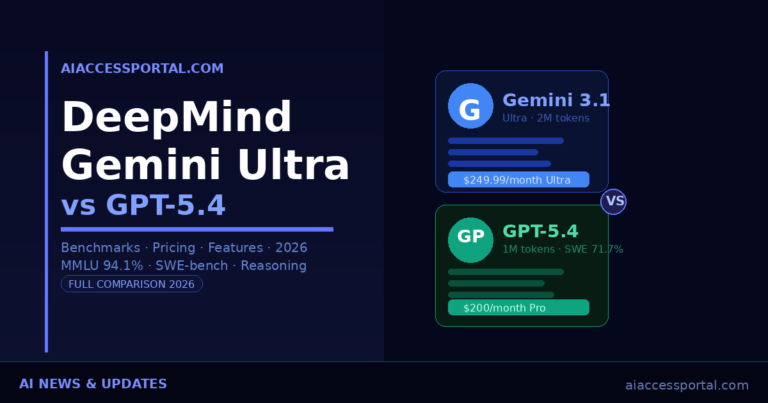
✅ Pricing: Gemini Ultra costs $249.99/month; GPT Pro (ChatGPT Pro) costs $200/month.
✅ Speed: Gemini 3.1 Pro outputs 120.3 tokens/sec — about 1.6x faster than GPT-5.4.
1. Gemini Ultra vs GPT-4: The 2026 Landscape {#landscape}
The AI model landscape shifted dramatically in March 2026 — a month many analysts are calling the most explosive in AI history. On March 5, OpenAI released GPT-5.4 “Thinking.” Three days later, Anthropic released Claude Opus 4.6. Google DeepMind followed with Gemini 3.1 — a multi-tier release spanning from Flash-Lite to the mathematically powerful Deep Think variant.
In the Gemini Ultra vs GPT-4 2026 context, it is important to note that “GPT-4” as originally released in 2023 has been significantly superseded. The current OpenAI flagship is GPT-5.4, while Google’s current flagship is Gemini 3.1 Pro — with Gemini Ultra being the premium tier. Both represent a generational leap beyond the models that originally established each company’s reputation.
2. Gemini Ultra vs GPT-4: Benchmark Scores {#benchmarks}
Here are the key April 2026 benchmark results:
| Benchmark | GPT-5.4 | Gemini 3.1 Pro | Winner |
|---|---|---|---|
| MMLU | ~90% | 94.1% | Gemini |
| SWE-bench Verified | 71.7% | ~68% | GPT-5.4 |
| HumanEval+ | 94-95% | ~92% | Tie |
| ARC-AGI-2 | Lower | Higher | Gemini |
| GPQA Diamond | ~78% | ~74% | GPT-5.4 |
| SimpleQA | Higher | Lower | GPT-5.4 |
| Speed (tokens/sec) | ~75 | 120.3 | Gemini |
GPT-5.4 wins five out of seven benchmarks overall, but Gemini 3.1 Pro leads on the two that arguably matter most for general intelligence: ARC-AGI-2 and MMLU.
3. Gemini Ultra vs GPT-4: Reasoning & Problem Solving {#reasoning}
In the Gemini Ultra vs GPT-4 2026 reasoning comparison, GPT-5.4 currently leads in structured, multi-step logical reasoning — the kind required for complex math problems, scientific reasoning chains, and formal logic.
GPT wins at complex reasoning, math, code interpretation, and structured problem-solving. Gemini 3.1 now competes directly with GPT-4o and o3 in complex reasoning. In structured writing, chain-of-thought clarity, and explainability, GPT still leads. But Gemini 3.1’s Deep Think variant wins or ties on many formal reasoning benchmarks.
For everyday reasoning tasks — answering questions, analyzing documents, planning projects — both models perform at an extremely high level that exceeds the needs of most users.
4. Gemini Ultra vs GPT-4: Writing Quality {#writing}
In the Gemini Ultra vs GPT-4 2026 writing comparison, the two models have distinctly different personalities.
GPT-5.4 is more expressive. It understands narrative structure intuitively, builds tension and flow, and maintains a stable tone across long pieces of writing. Whether you are crafting a blog, a sales script, or character-driven fiction, GPT keeps the voice consistent and intentional.
Gemini takes a different approach — often brighter, more literal, and more concise. It can be imaginative, but its outputs tend toward clarity over elegance. For technical writing, factual summaries, and structured documents, Gemini’s style is often preferable.
Winner for creative and long-form writing: GPT-5.4. Winner for concise technical writing: Gemini 3.1.
5. Gemini Ultra vs GPT-4: Coding Ability {#coding}
GPT-5.4 leads coding benchmarks with a 71.7% SWE-bench Verified score — the gold standard for real-world software engineering tasks. It also has a unique Computer Use capability that lets the AI take direct control of your desktop to perform tasks like filing expense reports, navigating web applications, or managing files.
Gemini 3.1 Pro is highly capable at coding but trails GPT-5.4 on SWE-bench. However, Gemini’s 2-million-token context window makes it uniquely suited for analyzing large codebases — a task where GPT-5.4’s 1M context window is a meaningful limitation.
Winner for coding tasks: GPT-5.4. Winner for large codebase analysis: Gemini 3.1 Pro.
6. Gemini Ultra vs GPT-4: Multimodal Capabilities {#multimodal}
In the Gemini Ultra vs GPT-4 2026 multimodal comparison, Gemini dominates. Gemini 3.1 Pro natively handles text, image, audio, video, and code — and Google has invested more in vision and video understanding than any other AI lab.
Gemini 3.1 Pro leads multimodal benchmarks by a meaningful margin. It can reason across modalities in a single conversation — analyzing a video frame while reading a document and writing a response — in ways that GPT-5.4 currently cannot match.
For designers, content creators, video producers, and anyone working with mixed media, Gemini’s multimodal superiority is a decisive advantage.
Winner for multimodal tasks: Gemini 3.1 Pro/Ultra — clearly.
7. Gemini Ultra vs GPT-4: Context Window {#context}
Context window size determines how much information a model can hold in its “working memory” at once.
| Model | Context Window |
|---|---|
| Gemini 3.1 Pro | 2,000,000 tokens |
| GPT-5.4 | 1,000,000 tokens |
Gemini’s 2M token context window is the largest among frontier models — double GPT-5.4’s already impressive 1M window. This means Gemini can process entire codebases, books, or hours of video in a single prompt — a capability that GPT cannot match.
Winner for large context tasks: Gemini 3.1 Pro/Ultra — by a significant margin.
8. Gemini Ultra vs GPT-4: Web Search & Real-Time Data {#search}
Both models support real-time web search, but Gemini has a structural advantage: deep integration with Google Search — the world’s largest and most accurate search index.
When Gemini searches the web, it draws on Google’s full search infrastructure including Knowledge Graph, Featured Snippets, and real-time indexing. This gives Gemini an edge for research tasks requiring current information, fact-checking, and multi-source synthesis.
GPT-5.4’s web browsing is capable but relies on Bing’s search index, which has a smaller footprint than Google’s.
Winner for real-time web research: Gemini 3.1 Pro/Ultra.
9. Gemini Ultra vs GPT-4: Pricing Comparison 2026 {#pricing}
| Plan | Gemini | GPT (OpenAI) |
|---|---|---|
| Free tier | Yes (limited) | Yes (limited, now with ads) |
| Standard paid | $19.99/mo (Gemini Advanced) | $20/mo (ChatGPT Plus) |
| Premium | $249.99/mo (Google AI Ultra) | $200/mo (ChatGPT Pro) |
| API pricing | $2/$12 per MTok (Gemini 3.1 Pro) | Higher for GPT-5.4 |
| Speed | 120.3 tokens/sec | ~75 tokens/sec |
Gemini is competitively priced and significantly faster at token output speed, making it more cost-effective for high-volume API use. However, the premium consumer tier (Google AI Ultra) costs $49.99 more per month than ChatGPT Pro.
10. Gemini Ultra vs GPT-4: Google Workspace Integration {#workspace}
For USA businesses and professionals already using Gmail, Google Drive, Google Docs, and Google Calendar, Gemini’s integration into the Google ecosystem is a decisive advantage.
Gemini can read your emails, summarize Drive documents, generate content directly in Docs, analyze spreadsheets in Sheets, and organize your Calendar — all natively, without switching platforms or copying and pasting content.
GPT-5.4 requires third-party integrations or manual context-providing to access your Google Workspace data. For the 3+ billion Google Workspace users worldwide, Gemini’s native integration is a major practical advantage.
Winner for Google ecosystem users: Gemini 3.1 Pro/Ultra — no contest.
Pros and Cons {#proscons}
Gemini Ultra Pros ✅
- 2M token context window — largest available
- Best multimodal performance (text, image, audio, video)
- Deep Google Workspace integration
- Faster output speed (120.3 tokens/sec)
- Better real-time web research via Google Search
- More competitive API pricing
Gemini Ultra Cons ❌
- Premium tier costs $249.99/month — more expensive than ChatGPT Pro
- Less expressive for creative writing tasks
- Smaller third-party app ecosystem than ChatGPT
- Desktop automation (Computer Use) not available
GPT-5.4 Pros ✅
- Better coding performance (71.7% SWE-bench)
- Superior creative and long-form writing
- Computer Use for desktop automation
- Largest ecosystem of Custom GPTs (3M+)
- Adopted by 92% of Fortune 500 companies
- Lower premium tier pricing ($200 vs $249.99)
- Best structured output for professional documents
GPT-5.4 Cons ❌
- Smaller context window (1M vs 2M tokens)
- Less capable multimodal performance
- Relies on Bing for web search (vs Google’s index)
- No native Google Workspace integration
- Free tier now includes ads
Who Should Use Which? {#whichone}
Choose Gemini Ultra if you:
- Work extensively in Google Workspace (Gmail, Drive, Docs, Sheets)
- Need to process very large documents, codebases, or videos
- Do research requiring real-time web data from Google Search
- Work with multimedia content across text, image, audio, and video
- Need fast, cost-efficient API calls at high volume
Choose GPT-5.4 if you:
- Prioritize coding quality and software development
- Need creative writing with consistent voice and narrative structure
- Want desktop automation via Computer Use
- Use a wide range of third-party integrations and Custom GPTs
- Work in enterprise settings (92% of Fortune 500 use ChatGPT Enterprise)
Expert Opinions {#experts}
“GPT-5.4 wins for coding and desktop automation; Gemini wins for long-context research and cost efficiency. These are the two leading frontier models of 2026, each with distinct advantages.” — NxCode, March 2026
“Gemini 3.1 Pro — 120.3 tokens/sec output, about 2x Claude and 1.6x GPT-5.4. Best balanced default: GPT-5.4 — competitive on every axis when a multi-model stack is not an option.” — Tech Insider, April 2026
“In the Gemini vs GPT comparison for 2026, GPT leads in creative reasoning and structured writing, while Gemini leads in real-time web search, multimodal understanding, and context window size.” — Sybill AI, April 2026
FAQs {#faqs}
Q1: Is Gemini Ultra better than GPT-4 in 2026? A: In 2026, the relevant comparison is Gemini 3.1 Pro/Ultra vs GPT-5.4. Gemini leads on multimodal tasks, context window, and speed. GPT-5.4 leads on coding, creative writing, and third-party integrations.
Q2: What is Gemini Ultra’s context window in 2026? A: Gemini 3.1 Pro offers a 2-million-token context window — the largest among any frontier model in 2026, double GPT-5.4’s 1M token window.
Q3: Which is cheaper — Gemini Ultra or ChatGPT Pro? A: ChatGPT Pro is $200/month. Google AI Ultra (Gemini’s premium tier) is $249.99/month. At the standard paid tier, both cost approximately $20/month.
Q4: Which model is faster — Gemini or GPT? A: Gemini 3.1 Pro outputs approximately 120.3 tokens per second — about 1.6x faster than GPT-5.4 at roughly 75 tokens/second.
Q5: Which is better for coding — Gemini or GPT-5.4? A: GPT-5.4 leads coding benchmarks with a 71.7% SWE-bench Verified score, and uniquely offers Computer Use for desktop automation. Gemini is better for analyzing large codebases due to its 2M token context.
Q6: Does Gemini Ultra work with Google Docs and Gmail? A: Yes. Gemini integrates natively with Gmail, Google Drive, Google Docs, Google Sheets, and Google Calendar — a major advantage for Google Workspace users.
Q7: Which AI model do Fortune 500 companies prefer? A: ChatGPT Enterprise has been adopted by 92% of Fortune 500 companies. However, Gemini Enterprise is growing rapidly, with clients including Figma, Gap, Mercedes, and others.
Q8: Can I use both Gemini Ultra and GPT-5.4? A: Absolutely — and this is what most power users do. Use GPT-5.4 for coding, creative writing, and automation. Use Gemini for large document analysis, multimodal tasks, and Google Workspace workflows.
Conclusion {#conclusion}
The Gemini Ultra vs GPT-4 2026 comparison — more accurately framed as Gemini 3.1 Ultra vs GPT-5.4 — reveals two extraordinary AI systems with genuinely different strengths. There is no universal winner. The best model for you depends entirely on what you need to do.
For most USA professionals, the ideal setup involves both: GPT-5.4 for coding, creative writing, and automation tasks; Gemini for research, large document analysis, multimodal work, and anything living in Google Workspace.
What is clear is that the gap between the best AI tools and everything else has never been wider — and the difference between using the right model for the right task and using a one-size-fits-all approach is increasingly measurable in productivity, quality, and competitive advantage.
Subscribe to aiaccessportal.com for weekly AI model comparisons, benchmarks, and news for USA users.