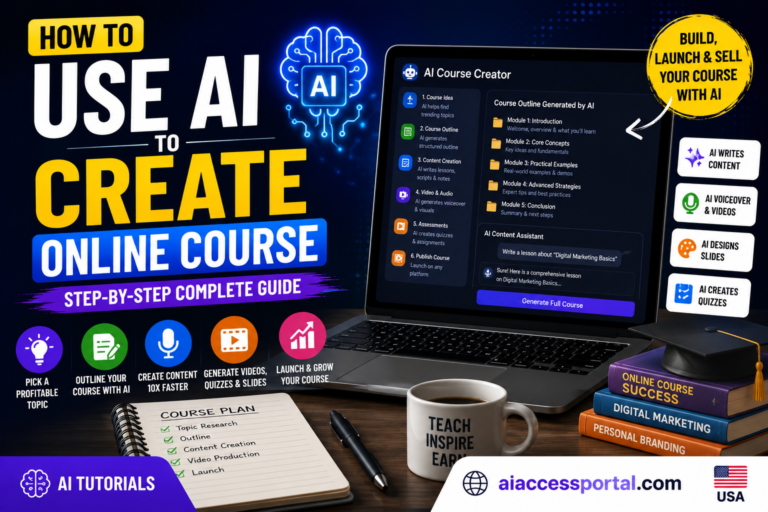
How to Use AI to Create an Online Course
If you want to learn how to use AI to create an online course, you are not alone. Thousands of creators, teachers, freelancers, coaches, and business owners are now using artificial intelligence to build online courses faster and more efficiently than ever before. AI tools can help with course outlines, lesson writing, presentations, voiceovers, quizzes, video production, and even marketing.
Creating an online course used to require expensive software, professional editing skills, and months of preparation. Today, AI tools simplify many parts of the process and help beginners launch digital courses without needing advanced technical knowledge.
In this guide, you will learn:
- What AI course creation means
- How AI helps build online courses
- Best AI tools for course creators
- How to create lessons using AI
- Ways AI improves video production
- How to market and sell online courses
- Common mistakes to avoid
- Tips for creating better educational content
Whether you want to create a course about business, fitness, freelancing, marketing, coding, or productivity, this guide will help you understand how AI can simplify online course creation.
What Does AI Course Creation Mean?
AI course creation refers to using artificial intelligence tools to help build educational content for online learning platforms.
Instead of manually handling every step yourself, AI can assist with:
- Topic research
- Course outlines
- Lesson writing
- Quiz generation
- Slide creation
- AI voiceovers
- Video editing
- Marketing content
AI helps creators work faster and organize information more efficiently.
For example, instead of spending days planning lesson structures manually, AI can generate detailed course outlines within minutes.
This makes online course creation easier for beginners and experienced educators alike.
Why Creators Use AI to Create an Online Course
There are many reasons creators are learning how to use AI to create an online course.
One major reason is speed.
Building a course manually can take months because creators must:
- Research topics
- Write scripts
- Design presentations
- Record videos
- Edit lessons
- Create assignments
- Promote the course
AI tools simplify many of these tasks.
Another reason is accessibility.
Many beginners may not have:
- Professional editing skills
- Graphic design experience
- Video production knowledge
- Large budgets
AI helps reduce these barriers.
Creators can now produce professional-looking courses with fewer technical skills than before.
How to Choose a Course Topic Using AI
The first step in creating an online course is selecting the right topic.
AI tools can help identify:
- Trending industries
- Popular learning topics
- High-demand skills
- Audience interests
For example, AI may suggest profitable course categories like:
- Social media marketing
- Graphic design
- Freelancing
- AI tools
- Fitness coaching
- Personal finance
- Productivity
- Coding
Choosing a course topic with strong demand improves your chances of attracting students.
The best online courses usually solve real problems or help people improve important skills.
How to Use AI to Create a Course Outline
One of the biggest advantages of AI course creation is automatic lesson organization.
AI tools can generate:
- Course structures
- Module ideas
- Lesson titles
- Learning objectives
- Topic progression
For example, if your course is about YouTube growth, AI might organize it like this:
Module 1 – YouTube Basics
Module 2 – Content Strategy
Module 3 – Video Editing
Module 4 – Audience Growth
Module 5 – Monetization
This saves significant planning time.
However, creators should still review and personalize outlines instead of relying entirely on AI-generated structures.
How AI Helps Write Course Lessons
Writing educational content takes time, especially for large courses.
AI writing tools can help generate:
- Lesson drafts
- Topic explanations
- Summaries
- Examples
- Assignments
- Discussion questions
This speeds up the writing process significantly.
However, the best online courses still include human experience and personality.
Students usually prefer courses that include:
- Real-world examples
- Personal insights
- Practical advice
- Authentic teaching styles
AI should support your creativity rather than completely replace it.
Using AI Voiceovers for Online Courses
Many course creators use AI voice tools for lesson narration.
AI voiceovers are useful because they:
- Save recording time
- Reduce equipment costs
- Improve consistency
- Offer multiple voice styles
Modern AI narration sounds far more realistic than older robotic text-to-speech systems.
Creators commonly use AI voiceovers for:
- Tutorials
- Presentations
- Educational videos
- Explainer lessons
However, some audiences still prefer real human voices because they feel more personal and authentic.
Many successful creators combine AI efficiency with their own personality and communication style.
How AI Helps Create Course Slides and Visuals
Professional visuals improve student engagement.
AI tools can help create:
- Presentation slides
- Infographics
- Diagrams
- Educational graphics
- Course thumbnails
This makes courses look more polished without requiring advanced graphic design skills.
For example, AI presentation tools can automatically generate slide layouts based on lesson topics.
Creators can then customize those visuals to match their teaching style.
Clean visuals and simple explanations often perform better than overly complicated designs.
How AI Improves Online Course Videos
Video production is often one of the most difficult parts of course creation.
AI video tools can help with:
- Automatic captions
- Background noise removal
- Script-based editing
- Scene generation
- AI avatars
- Video resizing
These tools speed up editing and simplify production workflows.
Some creators even use AI avatars instead of appearing on camera.
However, showing your real personality occasionally can help build stronger trust with students.
Authenticity remains important in online education.
Using AI to Create Quizzes and Assignments
Interactive learning improves student engagement and course completion rates.
AI can help generate:
- Multiple-choice quizzes
- Worksheets
- Homework assignments
- Flashcards
- Practice exercises
For example, if your course teaches photography, AI can create quiz questions related to:
- Lighting
- Camera settings
- Composition techniques
This saves time while improving learning experiences for students.
How to Use AI for Online Course Marketing
Creating a course is only part of the process.
Marketing is what helps attract students and generate sales.
AI tools can help creators produce:
- Sales page content
- Email campaigns
- Social media captions
- Blog articles
- Ad copy
- Video descriptions
AI can also generate multiple title ideas optimized for clicks and conversions.
For example, instead of:
“Photography Course”
AI might suggest:
“Beginner Photography Masterclass: Learn Professional Photography From Scratch”
Better titles can improve enrollment rates significantly.
Best Platforms to Sell Online Courses
After creating your course, you need a platform to host and sell it.
Popular online course platforms include:
- Udemy
- Teachable
- Thinkific
- Kajabi
- Skillshare
Each platform offers different features and audiences.
Some platforms are beginner-friendly, while others provide more customization and branding control.
Choosing the right platform depends on your goals and budget.
Common Mistakes When Using AI to Create an Online Course
Many beginners misuse AI tools during course creation.
Here are some common mistakes.
Relying Completely on AI
Courses that feel robotic or generic often perform poorly.
Students value authentic teaching and real expertise.
Creating Low-Quality Content Quickly
Publishing fast is not always better.
Focus on value, clarity, and useful lessons.
Ignoring Human Editing
Always review and improve AI-generated content before publishing.
Choosing Topics Without Demand
Research audience interest before creating your course.
Can AI Replace Human Teachers?
AI is powerful, but it cannot fully replace human expertise and communication.
The best online courses combine:
- AI efficiency
- Human creativity
- Personal experiences
- Practical insights
Students often connect more strongly with instructors who feel authentic and relatable.
AI works best as a productivity tool rather than a complete replacement for human teaching.
The Future of AI in Online Course Creation
AI tools are expected to become even more advanced in the future.
Future AI systems may help creators:
- Personalize lessons automatically
- Translate courses instantly
- Create interactive tutors
- Improve student analytics
- Generate adaptive learning paths
However, originality and quality will remain important.
Creators who combine AI tools with strong teaching skills will likely perform best long term.
FAQs
Can beginners use AI to create an online course?
Yes, beginners can use AI tools to simplify planning, writing, design, and video production.
Do I need expensive equipment to create online courses?
No. Many creators start with basic equipment and AI software.
Can AI create an entire online course automatically?
AI can assist with many tasks, but human editing and expertise are still important.
Which online course topics are most profitable?
Business, marketing, freelancing, technology, productivity, and fitness courses are very popular.
Are AI-generated course materials legal?
Generally yes, but creators should still avoid plagiarism and review platform policies.
Can AI voiceovers be used in paid courses?
Yes, many creators use AI narration professionally in educational content.
How long does it take to create an online course using AI?
AI tools can reduce production time significantly, sometimes from months to weeks.
What is the best platform for selling online courses?
Popular platforms include Udemy, Teachable, Thinkific, and Kajabi.
Conclusion
Learning how to use AI to create an online course can save time, reduce production costs, and simplify the entire course creation process.
Modern AI tools now help creators with lesson planning, writing, presentations, narration, quizzes, video editing, and marketing. This allows beginners and experienced educators alike to build professional online courses more efficiently.
However, the best online courses still depend heavily on human creativity, teaching ability, personal experience, and authentic communication.
AI should be viewed as a powerful assistant that helps creators work smarter while still maintaining originality and educational value.
As online learning continues growing, creators who learn how to combine AI efficiency with strong teaching skills will likely have even greater opportunities in the future.